
Corporate Hell Strikes Again
If you're indispensable, you're just a patch on a broken system.

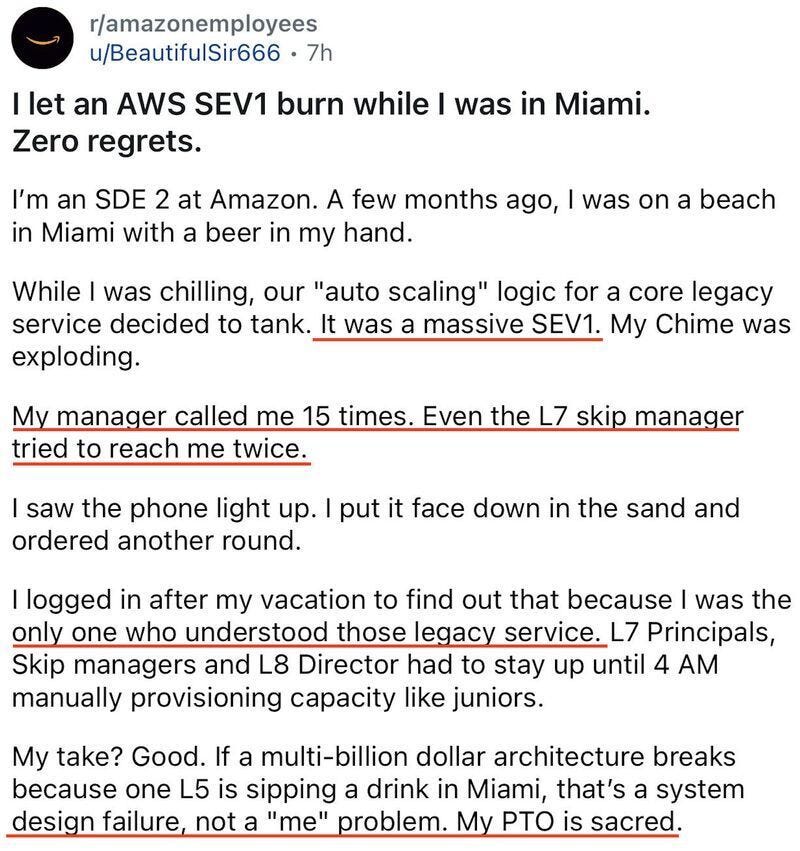
A developer at Amazon went to Miami. Beach, beer, the whole thing.
His phone started exploding. Services down, severity 1. His manager called 15 times. The guy above his manager tried twice.
He saw it. Put the phone face down in the sand. Ordered another round.
When he came back, he found out that the fire had spread up the hills. Principals and Directors had stayed up until 4 AM manually operating things, because he was the only one who understood how to fix the system. Senior leaders doing junior work in the middle of the night because one guy was on a beach.
His take? Good. If a multi-billion dollar architecture breaks because one engineer is sipping a drink in Miami, that’s a system design failure, not a “me” problem. My PTO is sacred.
He’s right. But let’s go deeper, because this story is a perfect window into what Corporate Hell actually looks like.
I’m not talking about the theatrical version with a screaming a-hole boss and 80 hours a week, but the version we have to live with every day. Where everything looks fine on paper, there are employee benefits, a reasonable compensation package and a cool logo on your LinkedIn profile, maybe even a foosball table and free snacks (that’s so 2000s).
But underneath, the whole thing is held together by specific people carrying knowledge that no one has access to. Undocumented. No bus factor considered, just institutional memory stored in someone’s head.
Speaking of which: does your company do bus factor testing? Not literally, but the exercise: if this person got hit by a bus tomorrow, what breaks? How many people would need to disappear before something critical breaks?
Most honest answers are uncomfortable. A well-run organisation runs that test regularly and treats a high bus factor as a Priority 1 issue, not a compliment to the person involved tap-on-the-back style, how special you are to us.
Everything works fine. Until someone goes to the beach.
Amazon is known to have technical debt issues, so even if this specific story is not real or accurate, I wouldn’t doubt this happens over there as well.
The worst part is how easy it is to not notice you've become that person. Specially among tech personnel, being that person feels good for a while. You’re walk with your head high. People need you specifically. It feels like leverage. You’re freaking batman.
Then slowly, it becomes a cage. Then a ball-and-chain inside the cage.
You can’t fully unplug on vacation. You can’t get sick. You feel a low-grade anxiety even on weekends. That awareness that something could break and need you specifically never really turns off. It just hums the whole time in the background of your life.
You became a single point of failure with an ok-ish salary and the illusion of PTO. Now think about it: would you accept this position for that salary anyway if you had no PTO and no weekends?
Sometimes, Corporate Hell isn’t only endless meetings and a broken coffee machine, although that seems pretty accurate as well. But in this case, it’s the torture of that background hum, that anxiety to “quickly check the notifications”.
Companies make this worse by rewarding exactly the wrong things. They don’t fix the structure, they reward the loco-live style, the improvisation, the “irreplaceability” of the guy who intentionally became their human wiki.
And the person who spent six months writing runbooks, cross-training their team, making themselves replaceable in the best possible sense so that the machine doesn’t stop gets ignored and asked how come they’re not critical for the operation.
So the incentives stay broken, firefighting looks productive, Structural resilience looks like overhead and the fragility accumulates until it materializes at 4 AM while someone’s manually operating a gazillion-dollar-system in their pajamas.
This kind of debt, both technical and organizational debt, always gets paid by the wrong people.
Corporate life is a rational choice, but only under certain conditions.
Stable income, define job description, benefits, career infrastructure you’d have to build yourself otherwise, that’s all real and very cool depending on the person’s profile. It’s worth it for a lot of people. Maybe even for those who are not corporate people, it’s worth it for a season even if it’s not forever.
But it only makes sense if the company is structurally sound enough to not turn you into a load-bearing wall. If your PTO is a business risk, the trade-off stops making sense. You’re getting paid the same and absorbing asymmetric risk carrying the fragility the company should have engineered away. Your compensation almost certainly doesn’t reflect that exposure, stress/health and lifestyle costs. You’re supporting multi-million dollar risks for a five or maybe six figure salary.
And that, my friend, that’s Corporate Hell with dental insurance.
This is exactly why going small by design is becoming the more attractive path for a lot of capable people.
Small has its own chaos, but in a smaller operation, the fragility is visible. If you’re the bottleneck, you know it. There’s no false sense of redundancy. You either fix it, price it in, or accept it with open eyes.
In large orgs, fragility hides behind org charts and architecture reviews and documentation that hasn’t been updated since 2019. Everything looks solid, until one engineer puts his phone face down in the sand.
Whether you think that the engineer in Miami was being irresponsible or not, he ran a stress test. And the system failed it. Now the most important question isn’t whether he should have picked up the phone, it’s why picking up the phone was ever the contingency plan.
Ask yourself honestly: if you disappeared for two weeks, what happens?
“Noisy but manageable”: you’re in a mature environment. The structure holds without you.
“Things would burn”: you’re not indispensable, you’re a structural crutch. And that distinction matters more than most people admit. Because if you’re in corporate, no one is really indispensable.
If the answer is the second one, you have two options: push to fix it from the inside, or stop mistaking the dependency for security and start asking whether the trade-off is actually worth it.
Corporate life can be great for some people, but only at companies designed well enough to deserve your time.
If yours isn’t, going small might not be a step down. It might be the smarter call all in all.