
Why Most Founders Are Brilliant Idiots With Business Cards
A 4-Minute Read That Will Save Your Business... Or Destroy Your Dreams

Justin Welsh Watched Everyone Else Fail While He Got Rich
In January 2022, Justin Welsh launched The Saturday Solopreneur newsletter. By the end of that year, he had over 77,000 subscribers. Today, he has over 175,000 readers and made over $4.15 million in 2024.
There’s one main reason Welsh succeeded while thousands of other creators flopped: He wasn't an impatient idiot.
While other creators were frantically launching newsletters, podcasts, courses, and social media channels simultaneously like caffeinated squirrels with ADHD, Welsh did something “revolutionary”: He focused on one thing until it worked.
He built his LinkedIn audience first. Then he launched his newsletter and perfected it before expanding further. Sequential execution instead of scattered desperation.
This methodical approach is why he's counting millions while his competitors are counting their mistakes.
The Expensive Stupidity Everyone Else Chooses
Every week, we watch supposedly smart creators make the same bone-headed mistake. They taste a little success. Maybe 1,000 newsletter subscribers, their first $10K month, or one viral post. BOOM. Their brains immediately short-circuit.
"I need to expand!" they think, launching everything simultaneously like digital Napoleon invading Russia in winter.
Launch the podcast nobody asked for. Start the course with zero validated demand. Build the community before understanding what people actually want. Hire virtual assistants to manage the chaos they created.
Fast forward six months. They're not running a business anymore, they're managing a trainwreck that would make a reality TV show producer weep with joy.
This isn't just solopreneurs being reckless. This stupidity infects everyone, from venture-backed startups to indie creators who definitely should know better.
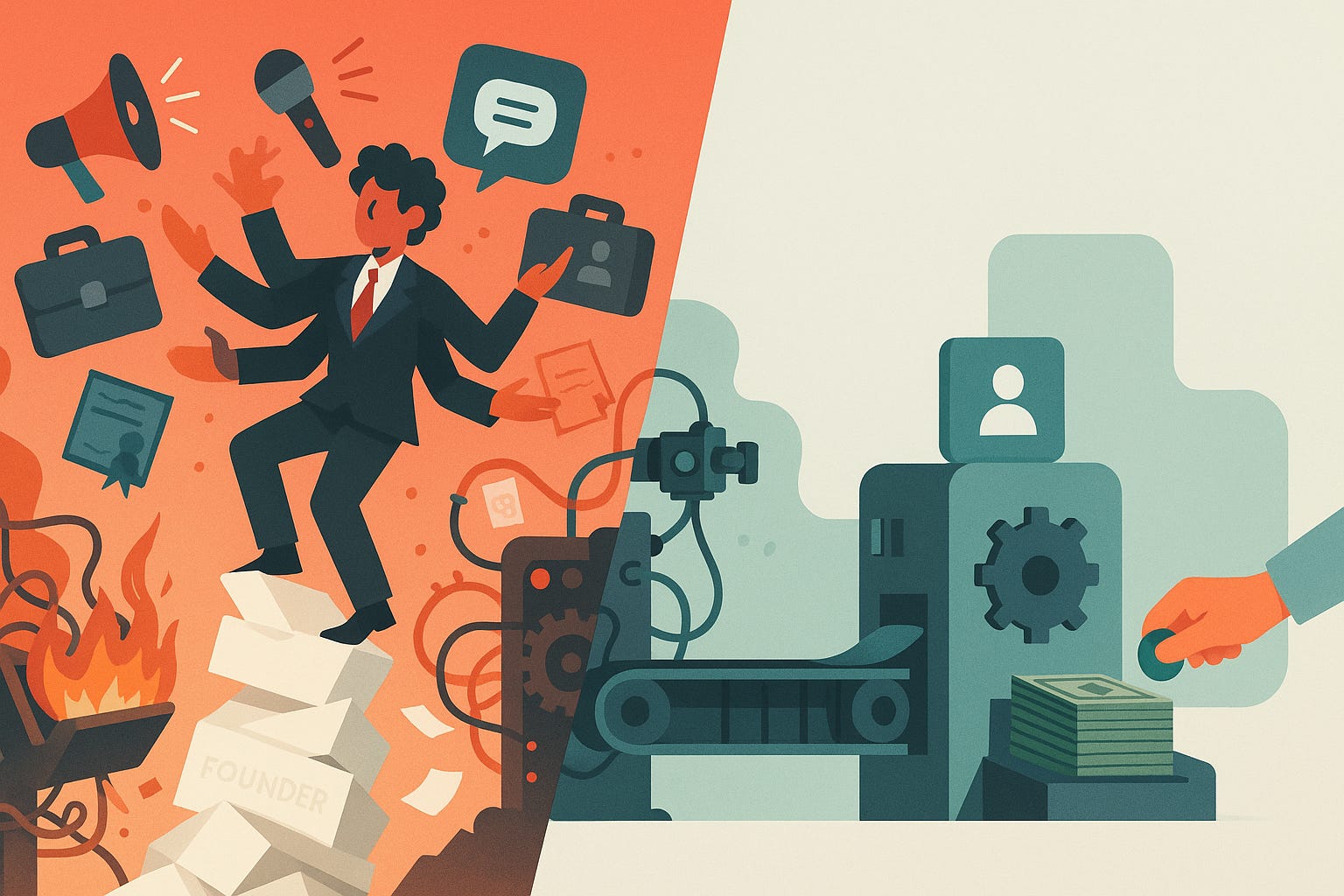
The Seductive Logic That Murders Companies
The thought process always sounds reasonable in their delusional little heads:
"I need more audience! Time to launch a podcast, course, and community!"
"I need more money! Let's hire contractors and expand to three new services!"
"I need more customers! We need more salespeople to capture this opportunity!"
Brilliant, innit? It sounds like what successful companies do. And that's exactly what makes it so perfectly, devastatingly wrong.
The cruel irony is that the founders who scale earliest are usually the ones who understand their business least.
They mistake activity for progress, complexity for sophistication, and expansion for validation. They're essentially cosplaying business executives while their fundamentals rot.
Let's look at real life cases and how they apply to smaller scale businesses, more specifically to solopreneurs, writers and creators.
The Real Case Studies That Should Terrify You
These companies that had everything going for them, until their own scaling obsession destroyed them.

Quibi: When Arrogance Meets Reality
Quibi raised $1.75 billion and launched with the kind of fanfare usually reserved for space missions. Jeffrey Katzenberg and Meg Whitman had Hollywood connections, celebrity content, and cutting-edge mobile technology.
The platform died after just six months, selling its content library to Roku for around $100 million. A 95% loss that would make casino owners blush.
Where it flopped: They invested over $1 billion in celebrity content and mobile optimization before testing whether anyone actually wanted to watch Hollywood shows on their phones in 10-minute chunks.
They built a $2 billion solution to a problem that didn't exist.

Pets.com: The $300 Million Dog Food Disaster
Pets.com went from its $82.5 million IPO to complete liquidation in 268 days. Not 268 weeks. Days.
Instead of solving their core challenge (how to profitably ship heavy bags of pet food) they hired armies of people and burned mountains of cash on… marketing. Remember that sock puppet? Its campaign alone cost more than most people’s houses.
They scaled infrastructure and hired talent to manage a business model that fundamentally couldn't compete with someone jumping in the car and driving to the pet store.

Webvan: Grocery Delivery's $1 Billion Funeral
Webvan's CEO literally said they would "figure out profitability later" while expanding to 26 cities after raising $375 million.
Spoiler alert: They never figured it out.
The company collapsed in 2001, having burned through nearly $1 billion. Their delivery model lost money on every single order, and adding more cities just meant losing money faster in more locations.
Now we could say that, to their credit, Webvan was a bit of the outlier here. The market for grocery delivery is out there, so it wasn't a market-fit problem. The problem existed. But they promised something they couldn't deliver (literally): fresh food at your doorstep in 30 minutes.
This required infrastructure that cost most of their financial means, which they tried to compensate by expanding fast.
But real Math doesn't care about your expansion plans.
The Three Delusions That Destroy Dreams
After watching this pattern repeat like a tragic sitcom rerun both at large companies like the ones above and small one-person businesses and solopreneurs who are confident they discovered a gold mine buried in plain sight, here are the three lies that smart founders tell themselves:
Delusion #1: "Growth Means We've Figured It Out"
Revenue growth feels like validation. It's not. It's often just dumb luck in a non-repeatable pattern.
For creators, this looks like viral growth on one platform leading to immediate expansion everywhere else, without understanding what made the original content work. They assume correlation equals causation and build strategies on accidents.
Reality check: Revenue growth without understanding the underlying drivers is just borrowed time with interest.
Delusion #2: "More People Will Solve Our Problems"
This is the business equivalent of thinking 9 women can deliver a baby in 1 month.
Adding people to broken processes doesn't fix the processes. It just makes the brokenness more expensive and harder to unravel. When you have a tangled piece of string, you sit down, quietly, and follow it to untangle it. You don’t call all your friends and ask everyone to start pulling at the same time.
For creators, this looks like hiring editors, designers, and virtual assistants before understanding what your audience actually wants. Now you have a team producing a boatload of polished garbage instead of one person producing unpolished garbage.
Reality check: You can't hire your way out of fundamental confusion about what you're doing.
Delusion #3: "We'll Figure Out the Economics Later"
This, my friend, is startup Russian roulette with a fully loaded gun.
Companies that assume growth will fix broken economics are like gamblers who think the next hand will win back everything they've lost. Math, specially statistics, doesn't work that way. Business doesn't work that way. Reality doesn't work that way.
Reality check: If your unit economics don't work at small scale, they won't magically work at large scale. Scale amplifies everything, including recklessness and stupidity.
What Actually Happens When You Scale Stupidly
The progression is predictable as gravity:
Month 1-3: The Honeymoon Delusion Everything feels exciting. New hires bring energy. Expansion plans create buzz. You feel like a visionary, a pragmatist, instead of someone who just lit money on fire because they didn’t do their homework.
Month 4-8: The Complexity Nightmare Simple decisions become committee decisions, even if it is a commitee of one. Clear, easy processes become confused workflows. Your original value proposition gets diluted like weak coffee. Quality drops faster than your bank balance.
Month 9-15: The Resource Hemorrhage Burn rate explodes while growth flatlines. New team members need management. New platforms need different strategies. Everything costs more and takes longer than your wildest pessimistic estimates. You have no money to pay the people you hired.
Month 16+: The Reckoning You've built a complicated monster that nobody understands, including yourself. Your best people leave because managing chaos isn't what they signed up for. You're trapped in a system too complex to fix quickly and too expensive to maintain.
You had a working business. Now you have an extremely expensive therapy session with a VAT number.
The Winners Who Actually Understand Reality
The founders and creators who build lasting wealth do something different. They resist the seductive pull of premature scaling like recovering addicts resist their drug of choice.
Instead of hiring their way out of problems, they solve the problems first.
Instead of expanding to prove they're successful, they become genuinely successful at one thing.
Instead of adding complexity to impress others, they build simple machines that print money reliably.
They understand the counterintuitive truth that the fastest way to scale is to delay scaling until you actually deserve to scale (or can't avoid it).
The Framework That Separates Winners from Casualties
Before making any scaling decision, the smartest founders ask four questions that most are too scared to answer honestly:
The Honesty Test: Can we explain in simple terms why customers choose us over alternatives? Not what we hope they care about but what they actually say when they recommend us.
For creators: Can you explain why people subscribe to your newsletter versus the thousands of others begging for attention?
The Predictability Test: Can we reliably turn marketing spend into customers? Not sometimes when planets align, rather consistently, predictably, boringly.
For creators: Can you create content that your audience engages with predictably, or are you throwing spaghetti at walls hoping something sticks?
The Math Reality Test: Do we actually make money on each customer with our current structure? Not theoretical future profits that require miracles. Real money hitting real bank accounts.
For creators: Do you understand your true cost per subscriber and lifetime value, including the value of your time, or are you just pretending numbers don't matter?
The Independence Test: Could our business run for a month without founders making daily operational decisions? If no, you're not ready for complexity.
For creators: Could someone else execute your content strategy using documented processes, or is everything trapped in your head?
These questions eliminate 90% of scaling disasters because most founders are too delusional to answer them honestly.
Most Founders Are All Over The Place. Don't Be That Guy.
Simple and profitable destroys complex and impressive every single time.
While competitors announce expansions and hiring sprees, smart founders quietly perfect their core business. While others manage expensive chaos, they build reliable money-printing machines.
While other creators launch different products on every platform simultaneously, the smart ones become the definitive voice of authority in their niche on one platform first.
When markets crash, and they always do, simple, profitable models survive and thrive. Complex, cash-burning operations become cautionary tales.
Speed isn't about doing more things. It's about doing the right things in the right sequence without getting distracted by shiny objects.
Your Moment of Truth
Look around at the founders and creators in your network. Not only here, but in “real life” as well. Notice the ones constantly announcing new hires, new platforms, new initiatives. Now notice which ones are actually building sustainable wealth versus managing expensive theater.
The difference isn't intelligence, work ethic, or evergreen luck. It's the wisdom to resist premature complexity like it's a communicable disease.
Before you scale anything, master the basics. Before you add team members, perfect your processes. Before you expand to new platforms, dominate your current one completely. Before you launch new products, understand why people buy (or not!) your existing ones.
The market rewards clarity, not complexity. Profitability, not impressive burn rates. Results, not good intentions.
Choose accordingly, or watch your business become another cautionary tale that smarter founders learn from. Because every founder, you and me included, thinks they're building the future. But most are just building tomorrow's business school case study on what not to do.
Happy building,
-R.
I work with solopreneurs, freelancers, and startups/scale-ups to turn messy processes into lean, reliable systems.
You can grab the same Notion templates and tools I use with clients to save hours of work, get organized, and stay in control.
Systems, Please! Is free. Support us by subscribing and sharing this article.